Features
Industries
Support
About

Use of ESdat by Australian Defence for Best-Practice Contaminated Site Data Management

Australian Department of Defence ESdat case study on contaminated site data management
The primary role of The Australian Department of Defence (Defence) is to defend Australia and its national interests, promote security and stability, and support the Australian community as directed by the Government. 1 Under Defence’s stewardship is the Defence property estate, the largest Commonwealth landholding, covering more than 3.8 million hectares. It comprises 70 major bases, more than 100 training ranges, more than 1,000 leased or owned properties and 30,000 built assets. 2, 3

THE CHALLENGE

Defence manages bases and sites within Australia where activities have resulted in soil, groundwater and surface water contamination, some of which have been the subject of extensive media coverage, such as the following article ABC News in August 20264. Defence have invested in national multi-year programs to address these soil, groundwater and surface water contamination impacts. One such program launched to address these is the “PFAS Investigation and Management Program” described on the Defence website as PFAS Investigation and Management Program | About | Defence 5
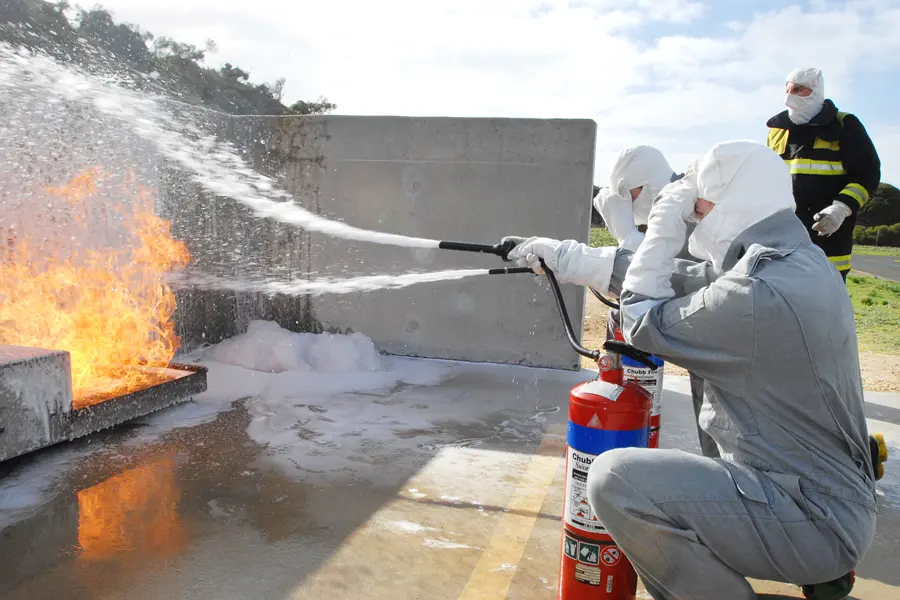
Defence personnel in protective suits using foam on a fire during firefighting training, a source of PFAS contamination
Figure 1 HMAS Arunta conducting fire training at the School of Survivability and Ships Safety on HMAS Stirling (FD2007) 6
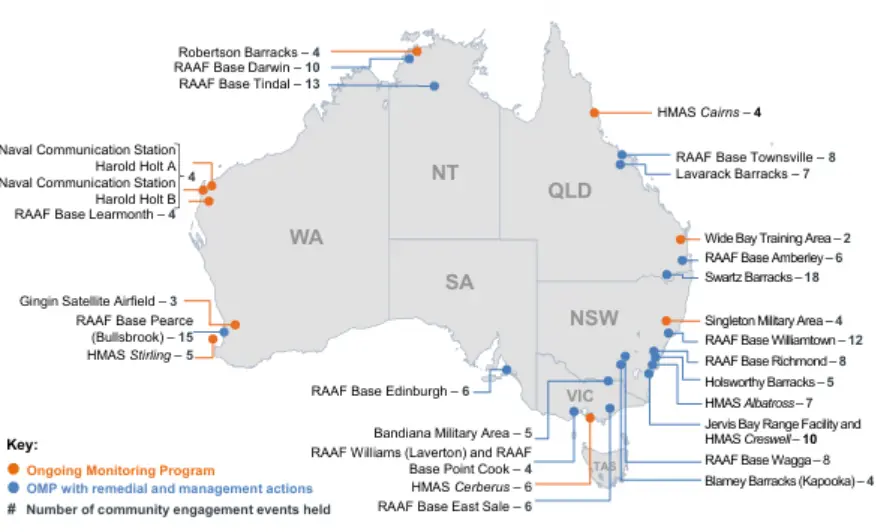
Map of Defence PFAS monitoring and remediation sites across Australia, including community engagement events held at each site
Figure 2 Snapshot of some of the many sites managed by Defence across Australia 7
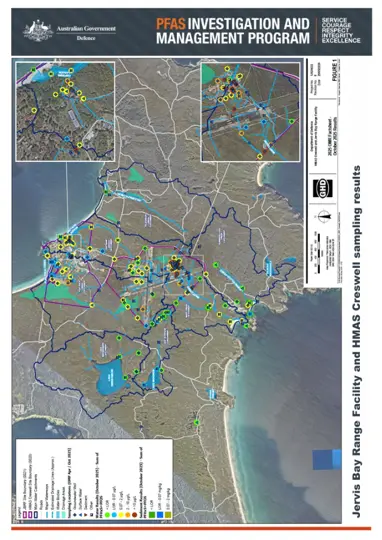
PFAS sampling results map for Jervis Bay Range Facility and HMAS Creswell from the Defence monitoring report
Figure 3 Jervis Bay Range Facility and HMAS Creswell sampling results 8

Defence engaged multiple consultancies and analytical laboratories to perform investigation and remediation programs of work.  This work involved the collection of large volumes of historical and ongoing site investigation data, and Defence needed to ensure that all this data was consolidated into one secure place, while also ensuring the highest quality of data management, security and accessibility.  

THE SOLUTION – ESdat Adoption and Integration

After assessing the options available in 2017, Defence engaged EarthScience Information Systems to provide a dedicated instance of the ESdat software and associated implementation and support services to ensure Defence’s data objectives were met. This resulted in a centralised ESdat solution being adopted for Defence’s environmental site data, including groundwater, surface water and soil investigations across the entirety of the Defence Estate.

EarthScience Information Systems, Defence and Consultants worked collaboratively to ensure protocols were developed and implemented so consultants and laboratories could load data directly into the Defence ESdat system, and all data was reviewed, complete, consistent, and reliable.  A key principle was that all results be verified and traceable to the original data provider.  The Protocols developed to achieve this were published by Defence in 2018 and amended in 2021 at: DCMM-AnnexL-DataManagement.pdf


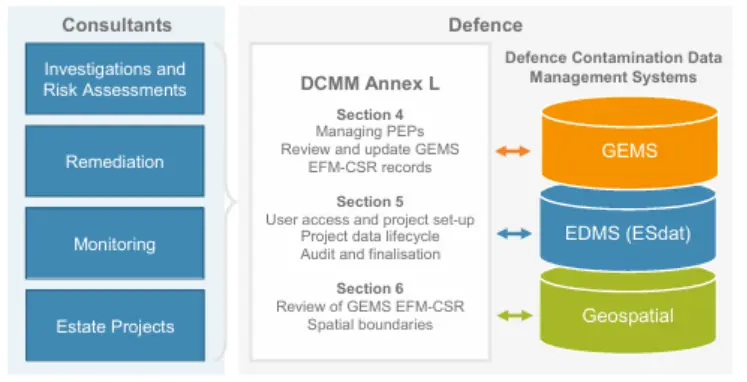
Diagram of Defence’s contamination data management systems linking consultants, DCMM Annex L, GEMS, ESdat and geospatial data
Figure 4 Diagram overview of CDMS 9

After 9 years of usage, Defence have consolidated over 20 million results into ESdat, collected by numerous consultancies and laboratories. As a result, Defence and key stakeholders can view the locations where sampling has occurred, visualise and monitor trends over time, and easily filter data to view analytical results and other site data using the tools available within ESdat and internal Defence systems linked to the ESdat database.

Consultants can rely on the existing data set when planning investigations and remedial activities, and stakeholders can review data for planned construction and maintenance, reducing sampling requirements and facilitating optimum material reuse. This accessible data system supports the critical large scale and long-term decision-making requirements for the Defence Estate.

THE OVERALL OUTCOME

Defence has an authoritative, centralised, reliable, industry-leading solution, giving them defensible contaminated land monitoring data from across their entire Defence estate.

Defence is able to easily access contamination data on its properties, and use the data for reporting, re-use assessments, and to inform future activities regarding land contamination and management across the Defence estate.

This has saved countless hours in administration, ensured all stakeholders can efficiently deliver and access quality data, and ultimately supported Defence in how they manage their overall risk and compliance.

About EarthScience Information Systems
EarthScience Information Systems produces Environmental Data Management Software 'ESdat', which is used by many of the world’s leading consulting, industrial, government, and mining organisations.  Within the Defence Sector ESdat is used by the Australian Department of Defence, NZ Defence Force, and the Canadian Department of National Defence.

EarthScience Information Systems’ vision is to always deliver the world’s best environmental and groundwater data management system, supporting our clients to work smarter and affect real change by understanding and providing solutions to their core data challenges.

1 Who We Are. (n.d.). Australian Government Department of Defence. Retrieved September 30, 2026, from https://www.defence.gov.au/about/who-we-are

2 Blenkin, M. (2026, February 5). Defence to consolidate its estate. Australian Defence Magazine. https://www.australiandefence.com.au/news/news/defence-to-consolidate-its-estate

3 Security and Estate Group. (n.d.). Australian Government Defence. Retrieved September 30, 2026, from https://www.defence.gov.au/about/who-we-are/organisation-structure/security-estate-group

4 Gregory, X. (2026, August 18). 3M accused of withholding toxicity of PFAS firefighting foam for decades. ABC News. https://www.abc.net.au/news/2026-08-18/pfas-3m-court-case-claim/107027292

5 PFAS Investigation and Management Program. (n.d.). Australian Government Department of Defence. Retrieved September 30, 2026, from https://www.defence.gov.au/about/locations-property/pfas

6 Commane, L. (2007). HMAS Arunta conducts fire training at the School of Survivability and Ships Safety on HMAS Stirling [Graphic]. https://images.defence.gov.au/assets/Home/Search?Query=20070704ran8109430_159020.jpg&Type=Filename

7 PFAS Investigation and Management Program Snapshot  – July 2026. (2026, July). Australian Government Department of Defence. https://www.defence.gov.au/sites/default/files/2025-09/Defence-PFA-Program-Snapshot.pdf

8 2025 Ongoing Monitoring Report: Jervis Bay Range Facility and HMAS Creswell. (2025). Australian Government Department of Defence. https://www.defence.gov.au/sites/default/files/2026-07/2025-Ongoing-Monitoring-Report-Factsheet.pdf

9 Annex L Data Management. (2021, June). Australian Government Department of Defence. Page 7. https://www.defence.gov.au/sites/default/files/2023-07/DCMM-AnnexL-DataManagement.pdf

Want to simplify your environmental data management?

More Case studies